To you, by chanceCreativity
Walking through Yoo Youngkuk's mountains in high summer
August photographs, opened again over the Chuseok holiday
Over the Chuseok holiday I finally sorted through the photos I had let pile up, and among them were the ones from the Yoo Youngkuk retrospective I saw in August. As I went through them one by one, the heat of that day came back to me, and then the cool air of the galleries.
It was the second Saturday of August. The heat wave had dragged on for days, and I had spent them lying on the floor beside Ong and Mong. I wanted a walk to clear my head, and while I was wondering where to go, a retrospective at the Seoul Museum of Art caught my eye. I took my camera out into the sun, and one door into the museum, the cool air dried my sweat almost at once.
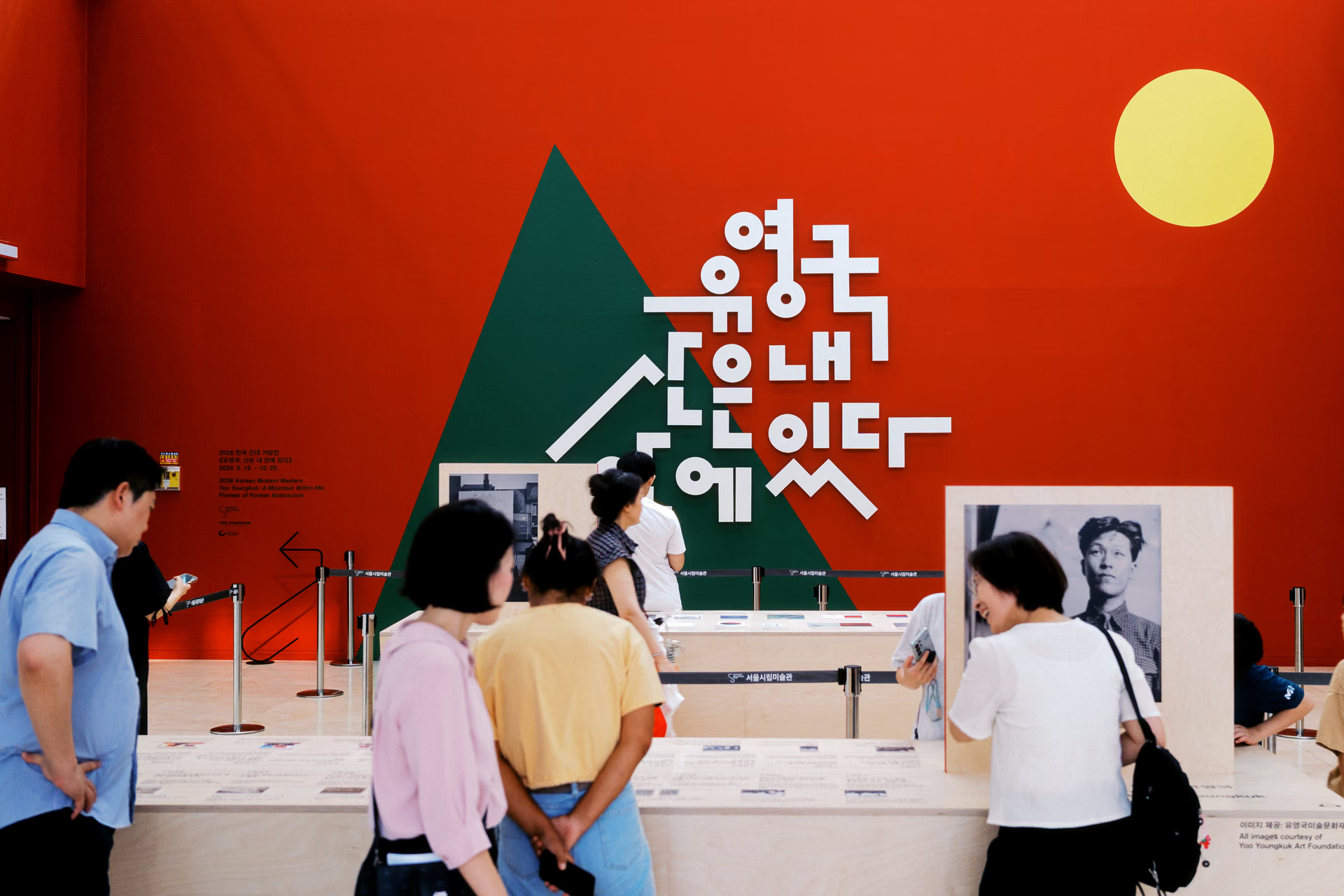
One wall of the entrance hall was orange from end to end, with a dark green triangle and the exhibition title above it. A Mountain Within Me. At the time I thought it was a nice line and walked on.
In the first room, with its white walls, each large painting had plenty of wall to itself. The first one divided the canvas between blue, green and black, with a yellow band running beneath them. It was titled simply Work. Why was this a mountain? Going by shape alone, I could hardly find one. But where the dark green overlapped the black was exactly the color of a mountain's shadow I knew well. Before it was a shape, the mountain was a color. That day, starting with this painting, I began giving each one a name of my own.
Had I looked up an explanation, the puzzle would have come apart quickly. But I suspected my imagination would shrink to exactly the size of the explanation, so I decided to stand there a while longer without knowing. A person in a white hat stood before the same painting for a long time, too. I wondered what they were seeing.
Other paintings opened up more easily. One brought to mind a mountain at sunset, another a winter mountain under snow, another simply an evening coming on. I had no way of knowing whether I was reading them right, but there was no one to tell me I was wrong. In front of this one, with white strokes rising loosely across a blue ground, I thought of mist wrapped around a mountain.
A small crowd had gathered in a corner of the room. People who had come together pointed at the paintings and talked in low voices, while those who had come alone stood silent with something in their ears. Whether it was the audio guide or their own music, I couldn't tell. Someone raised a phone to take a painting home. It was a room full of people, each drawing a mountain of their own.
In another painting, two white masses sat side by side on green. The one on the left was dense with fine vertical strokes, as if rain were falling inside it alone. I read it as two passing showers crossing a green field. It didn't need to be a mountain.
The year beside the first painting, 1964, was when he held his first solo exhibition, at forty-eight. While the painters around him were leaving for Paris and New York, he stayed in Seoul and withdrew into his studio. Staying behind while everyone else went out into the world can't have been an easy decision. Perhaps the mountain he was looking for had never been far away.
The next room was dark. The ceiling lights were off and only the paintings were lit, so each black wall held a single painting floating in it. The same colors ran deeper here in the dark than they had on the white walls.
When I like a painting, I tend to get as close to it as I can. I love work where heavy color sits thick on the canvas and you can feel every pass of the brush. What reads as a mountain from a distance turns back into paint up close. A red field beneath a silver peak, a dark crimson diamond inside a yellow band. Wherever one color met another, the thickness of the paint had become a ridgeline. Every close-up I took that day came from this habit.
The dark suited me. With nothing to look at but the paintings, each one filled my whole view the moment I stood before it.
Then I noticed someone who had stopped in front of one painting for a long time. A single black wall stood apart, carrying one painting of a white peak. Every mountain so far had been deep in color, so this first white one drew my eye as well.
Standing square in front of it, I saw a snow-covered peak rising over deep blue, with only the edge of the sky turning yellow. That is exactly how a snowy mountain looks before sunrise. While the valleys are still dark, the summit catches the light first. Even the darkness of the gallery felt like part of the valley, and I became someone at the foot of the mountain, waiting for day to break.
Another white mountain stood in a blue that deepened almost to black toward the bottom. Beneath it lay two red bars like embers. Up close, the paint was thick enough that the red actually rose from the surface, and the light cast a thin shadow along it. Some things only show when the lights go out.
Coming out of the dark, I found a gray wall with a square cut through its middle like a window. Through it I could see an orange painting. It felt like peering into someone's room from outside. There must have been a real mountain outside the window of the studio where he painted, but here, what hung beyond the window was a mountain he had painted.
Inside, everything was the color of sunset. The square painting at the center was orange as if heated in a fire, and the paintings on the walls to either side glowed orange and yellow too. There was red on every side, and yet somehow it wasn't loud. The reddest hour of the day is also the quietest.
Through a doorframe I saw a painting of blue folded like a bird on a yellow ground. In this exhibition, every door and window framed a painting.
Another showed green fields folding beneath a yellow sky. The ridgelines lay so low that it looked less like a mountain than the open fields at its foot. After all the mountains I had been looking up at, this time I felt as if I were looking down on one.
Along a long white wall, the paintings hung in a single row. One mountain stood as a lone triangle, another sat inside a diamond, and another was left as nothing but a few planes of color. It struck me all over again that one person had painted the same mountain in so many shapes.
Next came the sea. In a room that was blue right down to the floor, waves hung on every wall. My eyes, still warm from all that sunset, cooled in front of the blue. In high summer, just looking at blue is a kind of escape from the heat.
I stopped in front of one. Beneath blue and teal, white foam broke on a shore of apricot sand, beside a yellow hill and a single brown stone. I had thought of him only as a painter of mountains, and here he was painting the sea like this. Mountain or sea, what he painted in the end was layer upon layer of color.
This one left nothing to imagine. There was no need to ask which part was wave and which was sand. My imagination, run dry from naming abstract mountains all day, got a moment's rest. With nothing to imagine, I moved in closer instead. Where the foam broke, the white paint stood up thick from the canvas, and the marks of the brush had become the texture of the waves.
A low, wide bench faced the wave paintings. For the first time since I started walking, I sat down, and the waves came down to eye level. Outside was a summer in which simply walking was dangerous, and here I was, sitting by the sea and watching the waves. Once I caught my breath, I finally took in the space itself. The black walls that divided the dark, the gray wall cut through like a window, this seat facing the waves. The spaces Teo Yang had designed had been a pleasure all along.
Past the sea came things that weren't paintings. A wooden easel, crusted all the way down its legs where paint had run and dried again and again, and a chair beside it. Many of the mountains I saw that day must have been painted on that easel. According to the wall text, he laid the foundations of his abstraction in Yaksu-dong, arrived at his late abstraction in Deungchon-dong, and painted in Bangbae-dong until the end of his life. A whole lifetime, folded into the names of three neighborhoods.
One long wall was a shelf from end to end. Palm-sized paintings sat along it in rows, like dishes in a kitchen. A blue mountain, a green mountain, an orange mountain. The mountains that had filled whole walls now fit in the palm of a hand.
He never sold these small paintings, the story goes, and kept them by his side all his life. There is also a story that in winter, to save on heating, he painted at this size in a small room of his house. The paintings he kept so close were now gathered together on a single wall.
The last room was a warm brown. After passing back and forth between white light and black dark, the first thing my eyes noticed was the temperature. The light was yellowish, like the glow of an old incandescent bulb, less dark than cozy.
The two largest paintings I saw that day hung side by side. To take in either one whole, I had to step back several paces. Here the mountains had set down both their ridgelines and their thickness and moved into diamonds of many colors. They had come a long way from the first mountains, and still, at a glance, they were the same person's mountains.
I went up close and looked where the diamonds overlapped. I had assumed the borders between them were drawn with a ruler, but up close, they were drawn by hand. The lines wavered ever so slightly as they went. That wavering was what kept the lattice a painting instead of a diagram.
He painted these lattice mountains after he turned sixty. From sixty-one he lived with a pacemaker, and through thirty-seven hospital stays he never put down his brush. He set it aside only at eighty-three. And yet the colors on the canvas showed no sign of weariness at all.
On one of the brown walls hung a night painting in deep blue. A white moon floated in it, and the same moon floated once more on the water below. The longer I looked at the two moons, the more I felt as if I were deep underwater, looking up at the light on the surface.
At the end of the exhibition, a documentary about the painter was playing. Every seat was taken, people stood behind them watching the screen, and no one seemed in a hurry to leave. I wasn't the only one who had seen every painting and still wanted to know this man a little better.
The moment I stepped outside, the heat came back as if it had been waiting for me. The stone paving still threw back the light, and shade pooled thick only under the big trees. Through the leaves I could see the exhibition banner hanging on the museum wall.
On the way home, everything I had seen that day came back to me in no particular order. The large mountains on white walls, the colors deepening in the dark, the sunset beyond the window, the waves at eye level, the paint-crusted easel. But what stayed with me longest was a painting of a single green triangle standing on orange. I had walked past so many dazzling mountains, and yet a mountain made of one color and one shape held its own among them.
Sorting through the photos, my hand stopped on this one for a long time. More than a month and a half has passed, and that orange is still vivid. That day I took the line about the mountain within me for nothing more than a nice phrase and walked on, but now I think I understand it a little. The mountains I saw that day are still within me.